
Behind The Shot: Common Loon With a Crayfish
This is an image I’ve been dreaming of since I first started photographing these loons four years ago: a loon with one of their coolest prey species, a crayfish! Oh and of course, the very important green background!
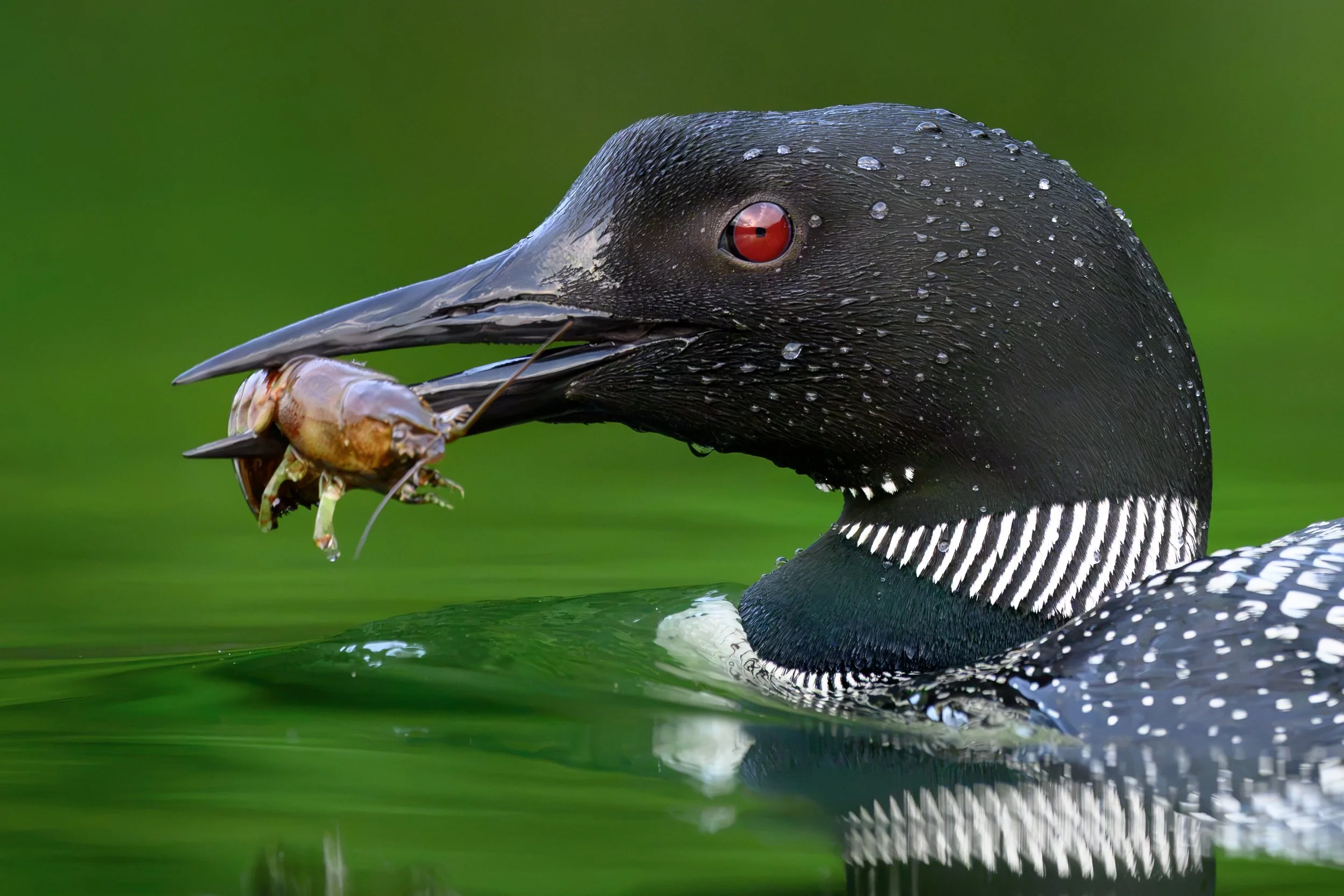
In all those four years, this was not the first time I’ve seen them feed their chicks crayfish and it wasn’t my first good photo either; it was just the first time I managed to capture THE image I had been chasing. So why did it take me four years?
There were several reasons, but the primary issue has always been light. The majority of feeding occurs in the early morning, and this pond is surrounded by steep hills that block all the early morning light. Without enough light, it’s incredibly difficult to use a fast enough shutter speed to freeze the movement during feeding. In fact, this image was captured at a shutter speed of 1/1000, which may sound fast, but in reality, out of all the feedings, very, very few images were sharp. Most had too much motion blur.
Even at 1/1000, my ISO reached 9000, which normally causes a ton of noise. Which was definitely the case for a few of my images from this morning. But it was a sacrifice I had to make if I wanted a chance of getting a single sharp image.
While limited light was the main struggle, there were still plenty of other challenges that made this photo all the more difficult.
Maintaining an ethical distance from the loons was probably the next hardest challenge. At the very least, it was the next obstacle I had to tackle on my journey to capturing the shot. As you can imagine, I want to be as close as I can to capture the highest-quality images, but there is still a respectable distance I strive to maintain. After spending four years with these loons, they sometimes allow me to get very close. But these moments tend to occur during downtimes, when I can just drift around without having to paddle or make any movements. However, during feedings, the loons do not remain still and normally travel along the shoreline in search of prey. Therefore, I have to try my best to keep up with them while also not paddling too much so as not to scare or disturb them. And man, that’s difficult when you then have to time picking your camera up.
Which brings us to the final puzzle piece: deciding when to bring my camera up and trying to time it with when the parents resurface with prey.
Loons tend to come up once they have a catch or run out of air. And because loons can hold their breath for five minutes (eight in extreme cases!), there can be long breaks before they resurface. But remember, loons are pros at fishing and can also resurface within just seconds. And now that the chicks are not-so-little anymore they have plenty of practice taking food from their parents now and can scarf it down within seconds.
Lastly, where they resurface is a guessing game. Imagine Whac-A-Mole, except instead of a table sized playing area it's a whole lake! Sometimes, they surface right next to the chick, and the whole exchange happens within seconds, and other times they come up fifty feet away.
In my case, the loon had surfaced a little ways behind me and swam beside me to give the crayfish to its chick. I had no idea if I had even managed to capture a single quality image until I got home and looked through my images. All of them had issues except for this one!
